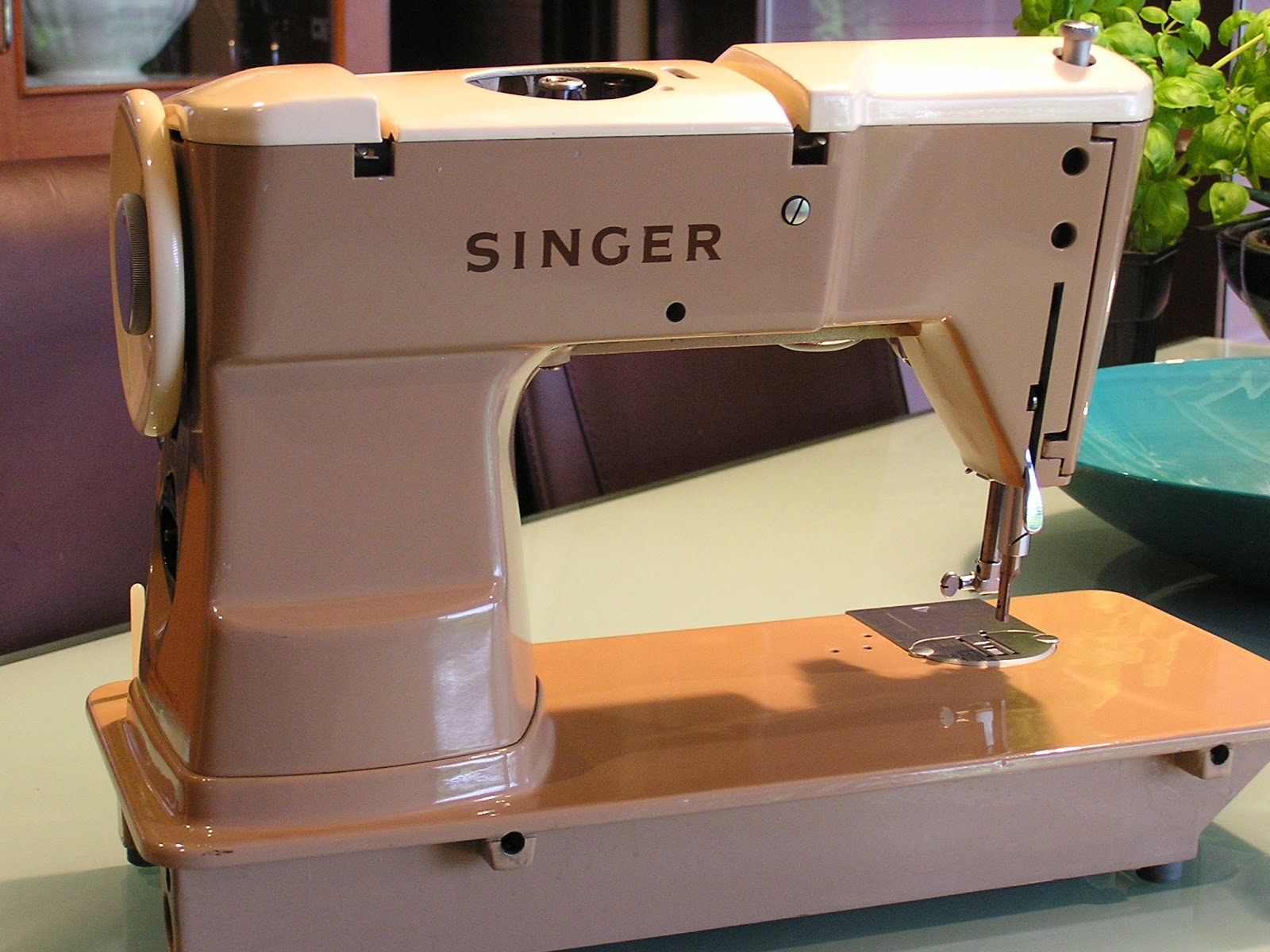
Now here's a cute little machine.
I like Berninas but I'm not too fond of the prices they fetch, so I only own machines that I can find at low prices. I found this one on CL, drove up north to pick it up, and stopped by a Value Village where I found some patterns, a box of Kenmore accessories, and, yes, another Kenmore. This Bernina is a slightly smaller machine, perhaps a 3/4 and has its own extension table, case, pedal/cord, and sewing table.
I haven't opened it up to take a look but I did open the lamp cover on the machine's nose and oiled all the usual suspects. It runs and sews beautifully, especially for a machine that has been in storage for quite a while. I didn't run it for very long, though, as I don't want to stress any parts that need lubrication. All the dials and controls seem to work perfectly.
There is a total of 7 stitches including straight. The top-most dial on the face controls width (outer) and needle position (inner). The center lever controls length and reverse with a dial limiter. The lower knob controls the feed dogs and the switch at the very bottom is a much-appreciated speed override switch: Max and Min settings. This machine is pretty quick, so the slower speed is good for concentrating on one's project rather than feathering the pedal speed as well as everything going on with the needle.
Cosmetically, it's very good. There are some very small paint dings and hairline scratches here and there and two slightly larger paint dings near the back of the free arm (probably caused by careless wielding of the bed extension).
As you can see, the motor housing, plate below the hand wheel, and the spool pin platform all suffer from UV suntan. Were I more retentive than I already am, I'd take those pieces and apply hair salon peroxide cream to bring them back to the original off-white. It's an easy process but since I probably won't keep this machine very long, I'll let the next owner have the honor.
I don't want to step on any toes as I mount my soapbox. We collectors all have our preferences and I am not nearly enough of an expert at any of this to question the judgment of anyone. However, I don't really understand the Singer Featherweight (221/222) fixation. They seem like nice little machines but $300 - $500 (or $1000 for a 222) buys several excellent machines that may arguably be superior at what its devotees claim it does. Here is a beautiful, lightweight, and extremely capable machine that offers multiple built-in patterns, plenty of power, and a sleek, modern design. When even a small Bernina can be used as a comparison against such price inflation, I'm given pause to reflect on the conception of value. I'm all about cheap machines and I understand that others may not be. But if my blog pages illustrate at least one thing successfully -- I believe, it is that quantity and quality are far from exclusive. I'm not a quilter. In fact, I'm not much of a sewer at all, so take my words with all the salt you can carry.
What do you think?
Me: shop around. Great deals can be had.
Pages
Showing posts with label cam stack. Show all posts
Sunday, September 13, 2015
Tuesday, May 19, 2015
Kenmore 158.1914
Ask and you shall receive. At least that's how it all went down today.
I found a CL ad for a Kenmore sewing machine stating that it is an 'old machine' but in working condition, including the foot pedal, all for $10. That could mean a lot of different things and there were no pictures in the ad. The price being right for just about any of those different things, I wrote to the seller asking whether they could post a picture or send one to me and she very promptly did so.
Every major brand of vintage sewing machine has one or more models that are considered holy grails within the line. For Kenmore, the Gritzner-Kayser machines, the 1802, and this one -- the 1914 -- are several such machines. Not necessarily expensive, they are recognized by collectors as particularly good examples of the best types of machines produced for the Kenmore name. The 1914 is considered by some as the best sewing machine ever built for Kenmore. I wouldn't go that far but it's certainly a nice one with some interesting features and a design that is a bit different from many of its predecessors: modern for the late '70s while retaining the classic durability for which Kenmore was known.
At first glance, the 1914 has a sleeker, simpler look than, say, the 1913 or the 1625. The integrated extension bed is identical to the 1913 but there is no obvious cam assembly and the reverse lever is body-colored, the length dial is smaller and flatter, and the top is a uniform slant all across the machine save for the cleverly designed slot in which the take-up lever can barely be seen. Where are the controls and features?
That sleek top is a hinged cover revealing most of the machine's controls including (left to right) the width dial, the cam assembly ('C' or top hat cams), cam release lever, bobbin winding tension disc post, stitch selection for cam stack stitches (including both stretch and forward-only stitches), and the bobbin winder. Reminiscent of the Singer 401A, the inside of the lid itself is a stitch chart. Very, very cool and very conveniently located.
The spool pins (or pin, in this case) are located at the back of this lid at an angle, part of the cast aluminum lid itself -- no screwed-on plastic parts here.
The free arm is revealed at the press of a button near the back, allowing the user to pull off the extension bed.
The front top plate of this extension bed can be removed by pressing yet another button on the side of the bed, thus revealing the bobbin area and feed dog lever, great for when you don't want to take off the entire extension.
The presser foot pressure control is a dial rather than the more traditional knob with twist collar and it's located behind the hinged nose:
So how does it sew? Well, it's an all-metal Kenmore with a 1.2 amp motor, a convertible, and has just about every feature a 1970s mass-produced sewing machine would have. It sews extremely well and I've owned it for just a few hours, cleaned up the exterior, and given it an oiling and de-dusting inside. It's smooth, it's powerful, and the stitches are excellent -- even straight stitches are great for a zig-zag machine, a true test of quality.
I've been looking for a 1914 for 2 years and finally found one after simply asking a seller what she had. Go get yours.
I found a CL ad for a Kenmore sewing machine stating that it is an 'old machine' but in working condition, including the foot pedal, all for $10. That could mean a lot of different things and there were no pictures in the ad. The price being right for just about any of those different things, I wrote to the seller asking whether they could post a picture or send one to me and she very promptly did so.
Every major brand of vintage sewing machine has one or more models that are considered holy grails within the line. For Kenmore, the Gritzner-Kayser machines, the 1802, and this one -- the 1914 -- are several such machines. Not necessarily expensive, they are recognized by collectors as particularly good examples of the best types of machines produced for the Kenmore name. The 1914 is considered by some as the best sewing machine ever built for Kenmore. I wouldn't go that far but it's certainly a nice one with some interesting features and a design that is a bit different from many of its predecessors: modern for the late '70s while retaining the classic durability for which Kenmore was known.
At first glance, the 1914 has a sleeker, simpler look than, say, the 1913 or the 1625. The integrated extension bed is identical to the 1913 but there is no obvious cam assembly and the reverse lever is body-colored, the length dial is smaller and flatter, and the top is a uniform slant all across the machine save for the cleverly designed slot in which the take-up lever can barely be seen. Where are the controls and features?
That sleek top is a hinged cover revealing most of the machine's controls including (left to right) the width dial, the cam assembly ('C' or top hat cams), cam release lever, bobbin winding tension disc post, stitch selection for cam stack stitches (including both stretch and forward-only stitches), and the bobbin winder. Reminiscent of the Singer 401A, the inside of the lid itself is a stitch chart. Very, very cool and very conveniently located.
The spool pins (or pin, in this case) are located at the back of this lid at an angle, part of the cast aluminum lid itself -- no screwed-on plastic parts here.
The free arm is revealed at the press of a button near the back, allowing the user to pull off the extension bed.
The front top plate of this extension bed can be removed by pressing yet another button on the side of the bed, thus revealing the bobbin area and feed dog lever, great for when you don't want to take off the entire extension.
The presser foot pressure control is a dial rather than the more traditional knob with twist collar and it's located behind the hinged nose:
So how does it sew? Well, it's an all-metal Kenmore with a 1.2 amp motor, a convertible, and has just about every feature a 1970s mass-produced sewing machine would have. It sews extremely well and I've owned it for just a few hours, cleaned up the exterior, and given it an oiling and de-dusting inside. It's smooth, it's powerful, and the stitches are excellent -- even straight stitches are great for a zig-zag machine, a true test of quality.
I've been looking for a 1914 for 2 years and finally found one after simply asking a seller what she had. Go get yours.
Sunday, March 29, 2015
Kenmore 158.1813
Here is yet another Kenmore I found at a thrift store. This is one of the wonderful 1970s machines with a built-in cam stack, cam assembly, and many other features -- a deluxe machine. It's in very good shape, as is the cabinet.
There's only one problem: it's missing the stitch selector knob that spins within the width dial. These knobs are common to several Kenmore models. Logging into eBay, I quickly found one, placed my order, and I will be fixing this machine within the next week or so.
This machine runs beautifully. Strong, quiet, smooth, makes excellent stitches that are uniform, and the tension is balanced. Everything you'd want in a domestic machine and all for $10. Once the $5 knob is added, this will have been another great score that I'll enjoy using.
There's only one problem: it's missing the stitch selector knob that spins within the width dial. These knobs are common to several Kenmore models. Logging into eBay, I quickly found one, placed my order, and I will be fixing this machine within the next week or so.
This machine runs beautifully. Strong, quiet, smooth, makes excellent stitches that are uniform, and the tension is balanced. Everything you'd want in a domestic machine and all for $10. Once the $5 knob is added, this will have been another great score that I'll enjoy using.
Labels:
1.2 amps,
158.1813,
1813,
1970s,
cam stack,
cams,
heavy duty,
Kenmore,
sewing machine
Wednesday, July 23, 2014
Singer 401A
We sewing machine collectors have all been through this: we see a machine for sale and it's a borderline case. It's missing a part or two. One of the missing parts is a power cord and so it can't be tested. It has a few dings. But it's a venerable model and one you don't yet own and the price is really low (this one was $9.99).
Buy it and put in the time and effort to raise it to the standard of the rest of your collection or pass and wait for a better example?
It's missing the power cord, the hinged door over the cam assembly, and has no feet or attachments. It has a few dings. No cabinet (thankfully) but also no carry case. I ran it using my 301A power cord (3-prong input on a 2-prong machine) and the light works and it runs, but slowly.
Fix it or part it?
Update: I have begun to refurbish this forlorn 401A.
As mentioned in the comments below, I purchased a hinged cover (the one with the decals) -- spool pins included -- and have both lubricated the captive bearing and cleaned the motor, i.e. polished the commutator, fired off the carbon from the brushes, cleaned the brass spring housings, etc. It had a broken stabilizing clip (replaced with one from an old Touch-and-Sew) and the insulation strip (the one that falls out when you take the motor apart) had been in the wrong position.
Not only does this machine now run, it runs like a bat out of hell. I now need to find a replacement cord and pedal and see if I can snag a box of slant feet and a cam or two. I'll then adjust the machine's settings to make sure all stitches can be sewn and I'll then put it up for sale.
I'm sure glad this is just a hobby, as I would have gone bankrupt long ago. As inexpensive as this machine initially was, I will likely put at least $50 into it in parts. Of course labor is never included. Still, it's a good feeling to get this thing running well if not quite sewing as yet.
Buy it and put in the time and effort to raise it to the standard of the rest of your collection or pass and wait for a better example?
It's missing the power cord, the hinged door over the cam assembly, and has no feet or attachments. It has a few dings. No cabinet (thankfully) but also no carry case. I ran it using my 301A power cord (3-prong input on a 2-prong machine) and the light works and it runs, but slowly.
Fix it or part it?
Update: I have begun to refurbish this forlorn 401A.
As mentioned in the comments below, I purchased a hinged cover (the one with the decals) -- spool pins included -- and have both lubricated the captive bearing and cleaned the motor, i.e. polished the commutator, fired off the carbon from the brushes, cleaned the brass spring housings, etc. It had a broken stabilizing clip (replaced with one from an old Touch-and-Sew) and the insulation strip (the one that falls out when you take the motor apart) had been in the wrong position.
Not only does this machine now run, it runs like a bat out of hell. I now need to find a replacement cord and pedal and see if I can snag a box of slant feet and a cam or two. I'll then adjust the machine's settings to make sure all stitches can be sewn and I'll then put it up for sale.
I'm sure glad this is just a hobby, as I would have gone bankrupt long ago. As inexpensive as this machine initially was, I will likely put at least $50 into it in parts. Of course labor is never included. Still, it's a good feeling to get this thing running well if not quite sewing as yet.
Labels:
cam stack,
fix,
made in USA,
parts,
Singer 401A,
slant,
zig-zag
Saturday, June 21, 2014
Kenmore 158.18150
Walking through a thrift store near my home, I spied two Kenmore sewing machine cases sitting snugly next to one another on the lowest shelf gathering dust. It was 50% Off Day at the local St. Vincent de Paul and I began to open the hard plastic cases (one in golden yellow, the other a mint green) with the odd mixture of hope, intrigue, amusement, trepidation, and excitement common to my other thrift store jaunts.
At this point in my collecting, I wasn't a fan of Kenmores. I grew up in a Singer household and we looked down on those who bought Kenmore machines. These two machines I purchased that fateful day convinced me that while Singer began to cut corners and produce inferior machines in the late '60s and 1970s, Sears' contracts with Jaguar/Maruzen and Soryu in Japan ensured they would be selling wonderful, all-metal, powerful machines into the early '80s.
I tested both machines at the store's testing station. The 1815 hummed as if it were brand new and despite a series of small scratches on the front rim of the bed, is in great shape. The other machine, a near-mint 158.19461, stalled and moaned. I tried moving the stitch selector, moving the needle bar by hand, checked under the top -- nothing changed. I took both to the register, explained the problem, and the employee very generously lowered the price of the 1946 from $20 to $2. And since this was 50% Off Day, I paid $10 for the 1815 pictured here and a whopping $0.99 for the 1946.
After figuring out the 1946, I soon found that I had purchased two very, very nice sewing machines. Smooth, powerful, quiet, beautiful stitches, consistent tensions -- these are keepers. The 1815 is a higher end model, as it has a substantial cam stack with utility stitches as well as a cam assembly for decorative options. That it's in a portable carrying case makes the machine even more valuable to me as I'm 6'2" and the tables in which one often finds these machines are too small for my long legs, often of questionable quality after decades of Big Wheel dents and science projects, and take up space in my increasingly small sewing space.
Have you ever engaged in Kenmore discrimination?
Labels:
1 amp,
158.1815,
1970s,
cam stack,
cams,
heavy duty,
Kenmore,
powerful,
sewing machine,
zig-zag
Subscribe to:
Posts (Atom)