I've decided that eBay is a venue that is by and large too expensive for sewing machine purchases. Shipping charges put many machines beyond my casual (and increasingly rational) addiction and shipping damage is always a concern. Yet, my tastes have changed. I acquire the low-priced common machines -- Kenmores, etc. -- mostly via CL and once in a long, long while will purchase a hard-to-find model from eBay if one is available at a price (+ shipping) that's not unreasonable.
Sometimes I even buy a fixer.
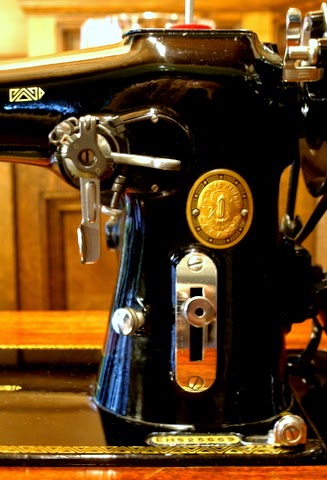
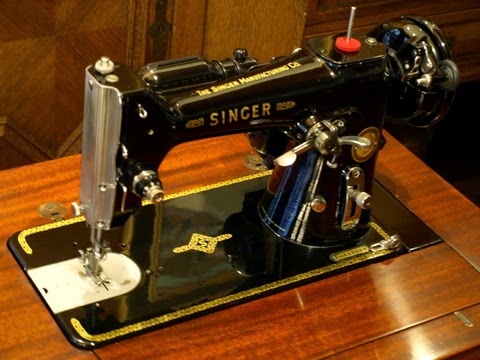
Case in point: the Anker RZ Matic zig-zag. I've been lusting for one of these for a while, having purchased an earlier Free-Westinghouse version. I've seen them in better shape but with price tags far above my self-imposed limit. So, when I saw the ad for this one (with 14 watchers), I figured I should probably pounce even though it's missing a slide plate, power cord/pedal, and most of a front decal. Other than these hopefully surmountable flaws (I see a cord/pedal combination for sale on eBay for more than I paid for this machine -- not going to happen) and despite a few small paint dings, it's actually in pretty decent shape. A standard Class 15 bobbin was included in its oh-so-common case and the hand wheel moves smoothly, quietly, and as heavily as a high-powered, over-engineered German machine should.
The machine has some very interesting features. The dual tension assembly is punctuated by the dual retractable pins and the forward-facing hook/race means double-needle sewing is de rigeur. Decorative stitching? You bet, all with a Wonder Wheel-like assembly powered by a third pulley off the hand wheel (first the interior motor, second the bobbin winder) and its own thread path with guides shared by a nifty bobbin winding assembly with automatic or manual stop-mechanism (see the small black Bakelite lever below the hand wheel). The top is reminiscent of a car hood, opening to a hinge that holds the open position until squeezed inward, releasing to the closed position. The stitch limiters around the width control are a beautifully designed pair of levers with numbered plates extending from the main knob, one each for both directions of the needle bar. This really is superior to the more typical thumb screws (and likely more expensive to manufacture and install). The setting release latch in the width lever doubles as a thread guide(!). Very cool. The length knob has a more standard cylindrical captive screw.
As a side note, I love the color: a deep sea green with dark green painted logo. The contrast with the nickel and black is stunning. Everyone should have at least one green sewing machine, don't you think?
All in all, I'm pretty happy with it despite not knowing how it runs. I have a Phoenix with a similar male connector and I will attempt a hook-up later today when I've some more time. I will append this post as soon as I have more information and have done a bit more cleaning.
I've also acquired a few more cheap paintings and will post a little gallery tour as well.
I hope you're all doing well.
Pages
Showing posts with label semi-industrial. Show all posts
Thursday, October 29, 2015
Monday, July 13, 2015
Meister 101
This past Saturday was a day I had been anticipating for several weeks.
My friend Janet -- someone I have become friends with through this blog and through her own, the very entertaining Suck It Up, Buttercup -- had found a Meister 101 in the wild, specifically Whitefish, Montana and offered to retrieve it for me. (She lives in beautiful Kalispell.) Like a true collector, she found yet another machine in my neck of the woods (the Seattle metro area), a Necchi BF Mira in excellent condition which I purchased for her; we agreed to meet in Spokane the aforementioned weekend to exchange machines and meet each other in person.
Janet's daughter Mariah was with her and according to Janet's own account, she remarked that though we had not met in person until then, it was as if we were continuing a conversation we had begun many years ago in which long stretches of absence never matter. Janet is as friendly, funny, generous, and genuinely nice as her blog posts and comments and in person even more so. The sewing community is filled with great people and Janet does our hobby proud; a shared interest often facilitates such meetings and I'm very glad we agreed to have a machine exchange. Thank you, Janet! I hope we can do this again.
As she knows, I'm particularly fond of German mid-century machines and this 1953 Meister 101 is a really wonderful example of the kind of engineering that makes them so smooth, powerful, and to me, desirable. I admit I haven't run the machine except to test that it works (and does it ever), but it is the beauty of the design and the cosmetic and mechanical condition that help make it such a great acquisition.
The width and length levers have an extremely long travel, facilitating very small adjustments. The hand wheel is large and set apart from the body, the needle position lever on top also being large and easily adjusted. I love the oil port arrow decals (and the red oil ports on both sides of the 1.0 amp motor), the hand wheel direction decal, and the limiting switch in the width lever. Sometimes found badged as a Sewmaster (though neither version is very common), much of the Meister's design reminds me of the Anker RZ, another German machine I really like.
The hand wheel moves with an ungodly amount of smoothness and without a single drop of oil I found it both heavy and free with the only sound being the rise and fall of the feed dog mechanism, a very soft click typically made by a precision instrument. The shafts and rods of this machine are very thick, particularly the secondary drive shaft. Like the Anker RZ, the Pfaff 130 and 30, and other German machines of this era, there is a semi-industrial level of quality here.
The nose plate reminds me of several German machines, notably the Anker RZ and some Pfaff models, although the Meister has an angled back edge that sets it apart.
Clearly this particular machine has seen very little use. It's near-mint and I am extremely pleased to have it. Once again, my gratitude is to Janet, a collector who has the eye and the passion for fine vintage machinery. The Meister 101 is more than a keeper -- it is among the top few machines in my collection.
(Hard to believe it's about 62 years old! Also hard to believe is the price: $30!)
My friend Janet -- someone I have become friends with through this blog and through her own, the very entertaining Suck It Up, Buttercup -- had found a Meister 101 in the wild, specifically Whitefish, Montana and offered to retrieve it for me. (She lives in beautiful Kalispell.) Like a true collector, she found yet another machine in my neck of the woods (the Seattle metro area), a Necchi BF Mira in excellent condition which I purchased for her; we agreed to meet in Spokane the aforementioned weekend to exchange machines and meet each other in person.
Janet's daughter Mariah was with her and according to Janet's own account, she remarked that though we had not met in person until then, it was as if we were continuing a conversation we had begun many years ago in which long stretches of absence never matter. Janet is as friendly, funny, generous, and genuinely nice as her blog posts and comments and in person even more so. The sewing community is filled with great people and Janet does our hobby proud; a shared interest often facilitates such meetings and I'm very glad we agreed to have a machine exchange. Thank you, Janet! I hope we can do this again.
As she knows, I'm particularly fond of German mid-century machines and this 1953 Meister 101 is a really wonderful example of the kind of engineering that makes them so smooth, powerful, and to me, desirable. I admit I haven't run the machine except to test that it works (and does it ever), but it is the beauty of the design and the cosmetic and mechanical condition that help make it such a great acquisition.
The width and length levers have an extremely long travel, facilitating very small adjustments. The hand wheel is large and set apart from the body, the needle position lever on top also being large and easily adjusted. I love the oil port arrow decals (and the red oil ports on both sides of the 1.0 amp motor), the hand wheel direction decal, and the limiting switch in the width lever. Sometimes found badged as a Sewmaster (though neither version is very common), much of the Meister's design reminds me of the Anker RZ, another German machine I really like.
The hand wheel moves with an ungodly amount of smoothness and without a single drop of oil I found it both heavy and free with the only sound being the rise and fall of the feed dog mechanism, a very soft click typically made by a precision instrument. The shafts and rods of this machine are very thick, particularly the secondary drive shaft. Like the Anker RZ, the Pfaff 130 and 30, and other German machines of this era, there is a semi-industrial level of quality here.
The nose plate reminds me of several German machines, notably the Anker RZ and some Pfaff models, although the Meister has an angled back edge that sets it apart.
Clearly this particular machine has seen very little use. It's near-mint and I am extremely pleased to have it. Once again, my gratitude is to Janet, a collector who has the eye and the passion for fine vintage machinery. The Meister 101 is more than a keeper -- it is among the top few machines in my collection.
(Hard to believe it's about 62 years old! Also hard to believe is the price: $30!)
Saturday, April 25, 2015
Bernina 640-2-11 Semi-Industrial
Oh, what a day.
I sold two items on CL and bought another, this beautiful machine:
According to what I've read online and from the seller, this is a semi-industrial machine used in light manufacturing. The lady who owned and used it for years was a professional seamstress and sewed all kinds of fabrics and leathers, even upholstery. She passed away and the daughter had no idea what to do with it and was grateful it was going to be out of her garage.
(It's strange that a daughter wouldn't want to keep and treasure an item that her own mother treasured. Do you think that's strange?)
Anyway, it runs so smoothly and quietly that you'd hardly know it's an industrial machine by just listening to it. The Consew .33 clutch is rather nice and seems a good pairing for a light industrial application. There is a walking foot included as well as a bunch of other feet. However, I'm not yet sure what it's set up to do, exactly. I'm interested in reading the manual just to see what it recommends and whether I can denote the differences between this particular model and the 5-- series and other 6-- series Berninas. Not a bad deal for $90.
I've only owned it for about 2 hours, so I'm still just looking at it, seeing where to oil it, etc.
And in other great sewing machine news today, my friend Janet wrote that she has snagged a really nice machine for me in a nearby state. It's raining machines. I can't believe this is all happening!
I sold two items on CL and bought another, this beautiful machine:
According to what I've read online and from the seller, this is a semi-industrial machine used in light manufacturing. The lady who owned and used it for years was a professional seamstress and sewed all kinds of fabrics and leathers, even upholstery. She passed away and the daughter had no idea what to do with it and was grateful it was going to be out of her garage.
(It's strange that a daughter wouldn't want to keep and treasure an item that her own mother treasured. Do you think that's strange?)
Anyway, it runs so smoothly and quietly that you'd hardly know it's an industrial machine by just listening to it. The Consew .33 clutch is rather nice and seems a good pairing for a light industrial application. There is a walking foot included as well as a bunch of other feet. However, I'm not yet sure what it's set up to do, exactly. I'm interested in reading the manual just to see what it recommends and whether I can denote the differences between this particular model and the 5-- series and other 6-- series Berninas. Not a bad deal for $90.
I've only owned it for about 2 hours, so I'm still just looking at it, seeing where to oil it, etc.
And in other great sewing machine news today, my friend Janet wrote that she has snagged a really nice machine for me in a nearby state. It's raining machines. I can't believe this is all happening!
Wednesday, April 22, 2015
Singer 206K25
I don't need another machine!
But I just couldn't resist this one. I have a 206K but I've always wanted a 206K25 and here it is, dragged home and cleaned up. It sews a beautiful zig-zag:
The machine's in excellent condition, save for a broken piece off the motor bracket where the outlet screw resides. It came with a buttonholer and templates, the original manual, and the standard issue box of attachments. Heck, it even came with the bench. I just have to figure out how to clean mold off of leatherette.
But I just couldn't resist this one. I have a 206K but I've always wanted a 206K25 and here it is, dragged home and cleaned up. It sews a beautiful zig-zag:
The machine's in excellent condition, save for a broken piece off the motor bracket where the outlet screw resides. It came with a buttonholer and templates, the original manual, and the standard issue box of attachments. Heck, it even came with the bench. I just have to figure out how to clean mold off of leatherette.
Saturday, October 25, 2014
Thursday, September 11, 2014
Pfaff 130 no. 2
I admit that I've overpaid for a few machines. And I admit that I've underpaid for others -- many others. Today, I was in a thrift store not looking for anything in particular and I just happened to walk by the furniture area where sewing tables can sometimes be found. Look what I found:
The price? $9.99. This 130 looks like it's been used maybe 10 times. The thing is absolutely beautiful and came with a metal Pfaff box full of feet and attachments, the original 1952 sales receipt, and a few other odds and ends. The cabinet is probably going to have to be destroyed -- I think it's too far gone. No power cord but the knee pedal and cord are very much intact. It was even clean, requiring just the usual wiping down, a little vacuuming in the crevices, and buffing of the chrome. I'm amazed no one else saw the value in this, as I was told it had been sitting there for a while.
To celebrate, I stopped by the Italian bakery nearby and bought biscotti, a Black Forest cake, lemon cream puffs, and sausage cannelloni with a house marinara sauce and a wedge of Reggiano for grating. So much for being thrifty, right?
Subscribe to:
Posts (Atom)